
It’s easy to assume that customer support and customer experience mean the same thing.
In practice, they refer to different aspects of how customers interact with a business.
Research and practical experience consistently show that customer support is only one part of delivering an outstanding customer experience.
Customer support is only one piece of the puzzle.
A business can have fast replies and still create a frustrating experience.
At the same time, another business can make customers feel understood, respected, and eager to return — even before anyone contacts support.
This article summarizes established customer experience and customer service principles drawn from industry research and practical business insights.
At NeoVisage, we study and apply these concepts when helping organizations create better digital experiences for their customers.
As we work toward our long-term goal of helping businesses build 500 high-converting websites by 30 March 2035, one principle continues to guide our approach:
Businesses that win long-term don’t merely solve customer problems.
They also design experiences people remember.
So in this post, let’s break down the real difference between customer support and customer experience, why it matters more than ever, and how it quietly affects your sales, referrals, retention, and reputation.
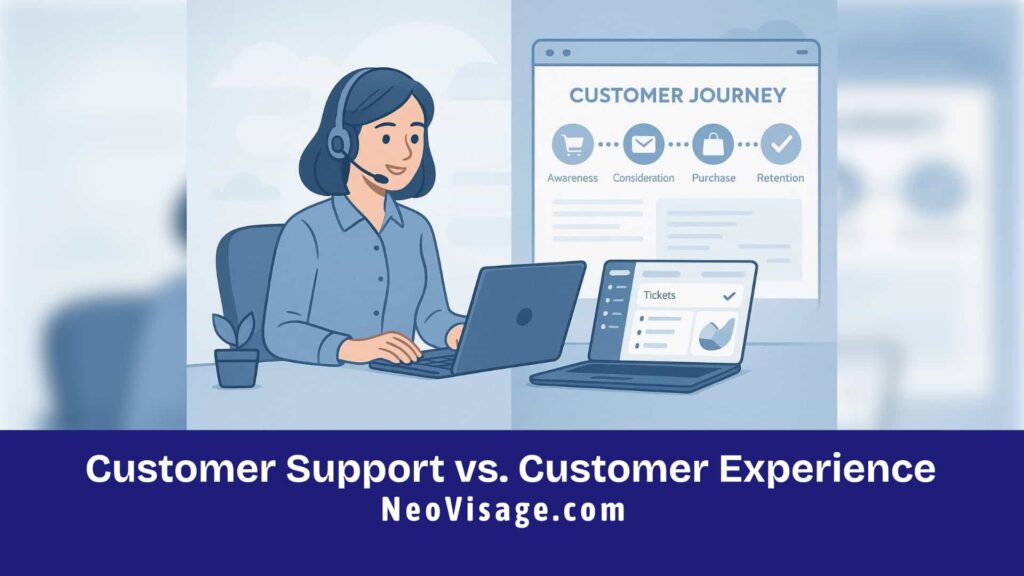
This article breaks down the real difference between customer support and customer experience, and why it quietly affects trust, retention, and conversions.
Table of Contents
- Customer Support vs. Customer Experience – Why Most Businesses Confuse Them
- Think of It Like Visiting a Restaurant
- Why This Difference Matters More Than Ever
- Customer Support – What It Actually Means
- Customer Experience – The Bigger Picture
- The Businesses People Never Forget
- The Silent Connection Between Customer Experience and Sales
- Customer Support Without Customer Experience Feels Exhausting
- So Which One Matters More?
- What This Means for Solopreneurs, Consultants, and Creators
- Why This Matters for Businesses Competing Online
- One Important Question Before You Leave
- Building Something People Trust
Customer Support vs. Customer Experience – Why Most Businesses Confuse Them
This confusion happens everywhere.
Ask many business owners what “great customer experience” means, and they’ll often say things like:
- “We reply quickly.”
- “Our support team is polite.”
- “We answer emails within 24 hours.”
Those things matter. A lot.
But according to experts like the Customer Experience Professionals Association (CXPA), customer experience is much broader than support alone.
Customer experience includes every interaction a customer has with your business — before, during, and after a purchase.
That includes:
- Your website speed
- Your checkout process
- Your email communication
- Your onboarding flow
- Your brand voice
- Your pricing clarity
- Your customer support
- Even how easy your website is to navigate
Meanwhile, customer support is more specific.
Customer support usually refers to the help customers receive when they have a question, issue, complaint, or technical problem.
In simple English:
Customer support is one moment.
Customer experience is the entire journey.
That difference changes everything.
Think of It Like Visiting a Restaurant
Here’s a simple example.
Imagine you visit a restaurant.
The waiter is friendly.
The food arrives on time.
They answer your questions politely.
That’s customer support.
But now think bigger:
- Was parking stressful?
- Was the environment welcoming?
- Was ordering easy?
- Did the restaurant smell clean?
- Did the music feel relaxing?
- Did payment feel smooth?
- Did they remember your preferences?
That’s customer experience.
The support interaction is only one part of how you feel about the brand.
The same thing happens online.
A consultant may have amazing support… but a confusing website.
Or a creator may answer DMs quickly… but have terrible onboarding.
Or a business may respond politely… but make customers wait 7 days for delivery updates.
People remember the overall feeling.
Not only one interaction.
Why This Difference Matters More Than Ever
Today’s customers have options.
Too many options.
If your business creates friction, confusion, delays, or stress, people can leave in seconds.
According to a report by PwC:
“32% of all customers would stop doing business with a brand they loved after one bad experience.”
Source: PwC’s report titled “Experience is everything: Here’s how to get it right”. PwC – Experience is Everything (PDF)
That’s huge.
It means customer experience is no longer a “nice extra.”
It directly affects:
- Retention
- Referrals
- Trust
- Sales
- Brand reputation
- Repeat purchases
And honestly?
This is one reason many businesses struggle online.
They focus only on aesthetics.
But people don’t only buy “beautiful.”
They buy:
- Clarity
- Ease
- Trust
- Confidence
- Simplicity
That’s why businesses that build websites that convert pay close attention to user experience, not just visuals.
Customer Support – What It Actually Means
Let’s define this properly.
According to HubSpot:
“Customer support helps customers solve technical problems or issues related to products or services.” [Paraphrased]
Source: HubSpot
https://blog.hubspot.com/service/customer-support
Customer support is usually reactive.
Meaning:
- A customer has a problem
- They contact you
- You respond
- You solve it
Examples include:
- Password reset help
- Billing issues
- Refund requests
- Technical troubleshooting
- Product setup help
Good customer support matters deeply.
In fact, many businesses lose loyal customers because support teams:
- Reply slowly
- Sound robotic
- Ignore emotions
- Transfer customers endlessly
- Fail to solve problems properly
But even excellent support cannot fully save a poor customer experience.
That’s the key point.
Customer Experience – The Bigger Picture
Customer experience is proactive.
It asks:
“How do we make every step easier, smoother, and more human?”
According to Salesforce, customer experience (CX) refers to how customers feel about a company based on the interactions they have with it throughout their journey. That journey can include everything from visiting a website for the first time, to buying a product, contacting support, receiving follow-up emails, or even recommending the brand to someone else. [Paraphrased]
Source: Salesforce – What Is Customer Experience (CX)?
https://www.salesforce.com/cx/what-is-customer-experience/
That means customer experience begins before support is ever needed.
For example:
A visitor lands on your website.
Questions immediately form in their mind:
- Is this trustworthy?
- Is this clear?
- Can this help me?
- Is this easy to use?
- Do I feel overwhelmed?
- Does this business understand me?
If your website feels confusing or stressful, support may never even get the chance to help — because the customer already left.
This is why user experience matters so much in high converting websites built by a digital marketing agency in Nigeria.
Good experience reduces friction before problems appear.
The Businesses People Never Forget
Think about the brands people recommend constantly.
Usually, it’s not because they had “support.”
It’s because:
- The process felt smooth
- The communication felt human
- The onboarding felt easy
- The website felt intuitive
- The business felt trustworthy
Emotion matters.
According to research published in the Harvard Business Review:
Emotionally connected customers are more valuable because they are more loyal and more likely to recommend brands. [Paraphrased]
Source: Harvard Business Review
https://hbr.org/2015/11/the-new-science-of-customer-emotions
This explains why customer experience has become such a massive competitive advantage.
People remember how businesses make them feel.
The Silent Connection Between Customer Experience and Sales
This is where things get interesting.
Many solopreneurs wonder:
“Why am I getting traffic but no conversions?”
Sometimes the problem may not be the offer.
Sometimes it’s the experience.
Examples:
- Slow-loading pages
- Confusing navigation
- Weak messaging
- Cluttered design
- Hidden buttons
- Poor mobile experience
- Complicated checkout flow
Every little frustration reduces trust.
Nielsen Norman Group research consistently shows that usability strongly affects whether users stay, trust, and complete actions online.
Source: Nielsen Norman Group
https://www.nngroup.com/articles/usability-101-introduction-to-usability/
This is one reason NeoVisage focuses heavily on creating:
- clean layouts
- clear messaging
- simple navigation
- strategic calls-to-action
Because high converting websites do not refer to “pretty websites.”
Rather, they are websites designed around human behavior.
Customer Support Without Customer Experience Feels Exhausting
Here’s a dangerous cycle many businesses fall into:
They create poor experiences… then rely heavily on support to fix the damage.
Examples:
- Customers can’t find information
- Checkout keeps failing
- Navigation is confusing
- Pricing isn’t clear
- Forms break on mobile
So support teams become overwhelmed solving preventable issues.
Great customer experience reduces unnecessary support volume.
This is why companies invest heavily in:
- UX design
- onboarding systems
- knowledge bases
- intuitive interfaces
- faster websites
Good experience prevents frustration before it begins.
So Which One Matters More?
Truthfully?
You need both.
Customer support and customer experience work together.
Here’s a simple way to think about it:
| Customer Support | Customer Experience |
| Reactive | Proactive |
| Solves problems | Prevents problems |
| Usually one interaction | Entire customer journey |
| Focuses on assistance | Focuses on feelings + usability |
| Happens after issues occur | Happens before, during, and after purchase |
Businesses that grow sustainably usually understand this balance.
Especially today.
Because customers compare experiences constantly.
Not only products.
What This Means for Solopreneurs, Consultants, and Creators
If you run a one-person business, this can feel overwhelming.
For many solopreneurs, balancing these responsibilities can feel overwhelming.
You’re handling:
- marketing
- sales
- delivery
- support
- content creation
- admin work
But even small improvements matter.
You don’t need perfection overnight.
Start with simple questions:
- Is my website easy to understand?
- Is navigation simple?
- Do visitors know what to do next?
- Does my onboarding confuse people?
- Do my emails sound human?
- Is it easy to contact me?
- Does my brand feel trustworthy?
These small improvements compound over time.
That’s how businesses slowly evolve into trusted brands.
Why This Matters for Businesses Competing Online
As internet usage continues growing across Africa and beyond, expectations are changing too.
People no longer compare your business only with local competitors.
They compare your experience with global brands.
That means businesses involved in:
- digital marketing in Nigeria
- content marketing in Nigeria
- web design
- consulting
- online education
- creator businesses
must think beyond aesthetics.
The future belongs to businesses that combine:
- trust
- clarity
- usability
- communication
- emotional intelligence
That’s why NeoVisage is committed to helping businesses create clearer, more trustworthy digital experiences while serving clients in Nigeria and beyond.
Not by chasing hype.
But by learning how people actually experience businesses online.
One Important Question Before You Leave
Here’s something worth thinking about:
Have you ever stopped buying from a business – not because the product was bad – but because the experience felt frustrating?
Maybe:
- the website confused you
- support ignored you
- checkout failed
- communication felt cold
- onboarding felt stressful
If yes, you already understand the power of customer experience.
So now the question becomes:
What kind of experience is your own business creating for people right now?
I’d genuinely love to hear your thoughts in the comments.
Building Something People Trust
At NeoVisage, we continuously study and apply research-backed principles that help businesses create trustworthy, memorable, and effective digital experiences.
One lesson consistently stands out:
Businesses grow faster when customers feel understood.
Businesses grow faster when customers feel understood. Share on XNot manipulated.
Not pressured.
Understood.
And honestly, that changes how you approach everything:
- your website
- your messaging
- your onboarding
- your emails
- your support
- your design choices
If your business experience currently feels messy, confusing, or disconnected, don’t panic.
Most businesses start there.
The important thing is recognizing the gap – and fixing it intentionally.
And if you’d like a second pair of eyes on your website, user journey, or customer experience flow…
You can reach out here: https://neovisage.com/contact/
No pressure.
Just clarity, honest feedback, and practical improvements that can help your business feel easier to trust.
References & Sources
- PwC – Experience is everything: Here’s how to get it right
https://www.pwc.com/us/en/advisory-services/publications/consumer-intelligence-series/pwc-consumer-intelligence-series-customer-experience.pdf - HubSpot – What is Customer Support?
https://blog.hubspot.com/service/customer-support - Salesforce – What is Customer Experience (CX)?
https://www.salesforce.com/cx/what-is-customer-experience/ - Harvard Business Review – The New Science of Customer Emotions
https://hbr.org/2015/11/the-new-science-of-customer-emotions - Nielsen Norman Group – Usability 101: Introduction to Usability
https://www.nngroup.com/articles/usability-101-introduction-to-usability/